 Member
 Dr. Gajanan
MemberForum Replies Created
-

1. Disease Prevention<div>The appropriate vaccination schedule will minimize the risk of significant infectious diseases (e.g., Newcastle disease, Gumboro, Marek, Infectious Bronchitis). Healthy birds use nutrients on growth, egg production and immunity instead of combating infections. Fewer deaths and illnesses are an improvement in the uniformity of the flock.</div>
<div>2. Growth and Feed Conversion</div><div>Birds that have good immunity also have good feed conversion ratio (FCR) as nutrients are utilized effectively.</div><div>Unvaccinated or poorly vaccinated flocks can have subclinical infections which decrease weight gain and egg production </div>
<div>3. Uniformity</div><div>Regular vaccination provides uniformity of the flock that is important in:</div><div>Broilers → attainment of target slaughter weight in good time.</div><div>Layers – mutual synchrony (lay and sustained) egg production.</div>
<div>4. Long-Term Immunity</div><div>The maternal antibody (day old chicks) levels are taken into account in the vaccination schedule to prevent interference. Long term immunity is achieved through proper priming and boosting (e.g. in the case of Newcastle, Gumboro).</div><div>
</div><div>5. Economic Impact</div><div>Vaccination is an expense but the payoff is increased productivity, reduced mortality, improved uniformity and reduced drug use.</div><div>Ineffective schedules contribute to higher risk of outbreaks that result in increased costs in terms of treatment, losses and culling.</div> -

Twice morning and evening time
-

How many times should eggs be collected daily to ensure freshness and reduce damage?
-
How do vaccination schedules impact overall flock performance?
-
How can early signs of common poultry diseases be detected in a flock?
-
How does feed composition affect egg quality and production?
-
What nutritional strategies can improve egg size, shell quality, and laying frequency?
-

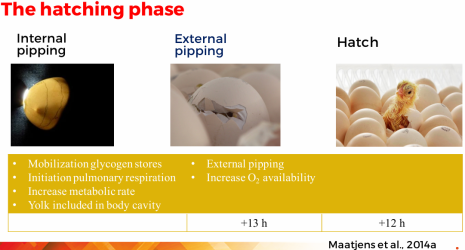
Dear Members, please share your views on this Hatching Phase step.
-

integration of Mass Spectrometry (MS),
-
The best time to use probiotics and prebiotics for poultry is at times of stress or at the beginning of their life, such as at hatching, during transportation, or after antibiotic use.
-
Water quality is shaped by two key factors: pH and ORP.
pH tells us how acidic or alkaline the water is. The scale runs from 0 to 14, with 7 being neutral. Water between 6 and 6.5 is generally ideal for farm use. If it’s too acidic or too alkaline, it can affect animal health, nutrient absorption, and even encourage microbial growth.
ORP, or Oxidation-Reduction Potential, measures the water’s ability to disinfect itself. It’s expressed in millivolts (mV). The higher the ORP, the stronger the water’s ability to kill bacteria and viruses. ORP above 600 mV is considered excellent for disinfection, while values below 250 mV suggest poor microbial control.
Now, looking at your farm water results:
-
Farm 2 has the best water quality. Its pH is 6.5 (ideal) and ORP is 700 mV (strong disinfection).
-
Farm 4 is at highest risk of bacterial contamination. Although its pH is acceptable at 7.2, the ORP is just 160 mV, which means weak disinfection power.
In short, pH sets the chemical environment, and ORP tells you how clean and safe that environment really is.
-
-
yes crt