

 Member
 Lina Paola Pardo Quevedo
MemberForum Replies Created
-

Water fit for drinking and feed that contain the right nutrient in adequate proportion should be provided to the birds at all times.
-

to neutralize the chlorine,
stable the PH,
enhance microorganism viability,
coloring the vaccine to view administration of vaccine
-

What kind of vaccine stabilizer could be used for live vaccine administration
-

Fish in the wild have diverse diets depending on their species and environment. Some fish are carnivores feeding on smaller fish, crustaceans, and insects, while others are herbivores grazing on algae and aquatic plants. Many species are omnivores, consuming both plant and animal matter, and their diets can include plankton, insects, and smaller fish, helping maintain the balance of their ecosystem.Fish in the wild have diverse diets depending on their species and environment. Some fish are carnivores feeding on smaller fish, crustaceans, and insects, while others are herbivores grazing on algae and aquatic plants. Many species are omnivores, consuming both plant and animal matter, and their diets can include plankton, insects, and smaller fish, helping maintain the balance of their ecosystem.
-
Fish in the wild have diverse diets depending on their species and environment. Some fish are carnivores and feed on smaller fish, crustaceans, and insects, while others are herbivores and graze on algae and aquatic plants. Many species are omnivores, consuming both plant and animal matter. In general, fish in the wild eat a variety of food sources, including plankton, insects, crustaceans, smaller fish, and aquatic plants, which helps maintain the balance of their ecosystem.Fish in the wild have diverse diets depending on their species and environment. Some fish are carnivores and feed on smaller fish, crustaceans, and insects, while others are herbivores and graze on algae and aquatic plants. Many species are omnivores, consuming both plant and animal matter. In general, fish in the wild eat a variety of food sources, including plankton, insects, crustaceans, smaller fish, and aquatic plants, which helps maintain the balance of their ecosystem.
-

🧠 Understanding Anti-Nutritional Factors in Feed: A Simplified Guide
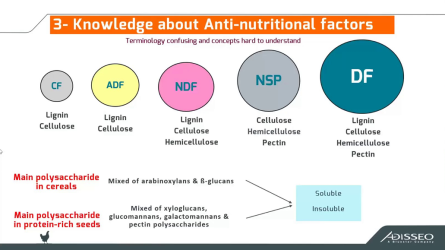
Fiber terminology in animal nutrition can be a maze—CF, ADF, NDF, NSP, DF—each with overlapping components but distinct implications. Here’s a clear breakdown to help navigate it:
🔹 Crude Fiber (CF) includes lignin and cellulose. It’s a traditional metric but underestimates total fiber content.
🔹 Acid Detergent Fiber (ADF) also includes lignin and cellulose. It’s useful for assessing digestibility—higher ADF often means lower digestibility.
🔹 Neutral Detergent Fiber (NDF) expands on ADF by adding hemicellulose. It reflects bulk and influences voluntary feed intake.
🔹 Non-Starch Polysaccharides (NSP) focus on cellulose, hemicellulose, and pectin. These affect gut viscosity and microbial fermentation.
🔹 Dietary Fiber (DF) is the broadest category, encompassing lignin, cellulose, hemicellulose, and pectin. It bridges both soluble and insoluble fiber fractions.
🌾 In cereals, the dominant polysaccharides include arabinoxylans and β-glucans, along with xyloglucans, glucomannans, galactomannans, and pectins.
💧 Soluble fibers like pectins and β-glucans increase digesta viscosity and modulate microbiota. 🪵 Insoluble fibers such as cellulose and lignin enhance gut motility and reduce transit time.
🎯 Why This Matters Accurate fiber classification enables:
-
Better enzyme targeting
-
Reduced anti-nutritional impact
-
Improved feed efficiency
-
Tailored gut health strategies
-
-

The best feed technology for floating fish feed is the extrusion technology specifically, twin-screw or single-screw extrusion systems depending on your production scale and target species.
-

Dear Poultry professional colleagues,
Today (10.10.2025) is the WORLD EGG DAY
The theme for this year is “The Mighty Egg : Packed with Natural Nutrition”
On this day, let us recollect our knowledge on Importance of eggs in Human nutrition and health.
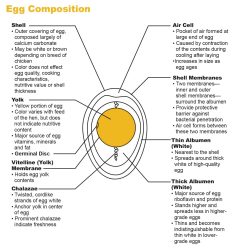
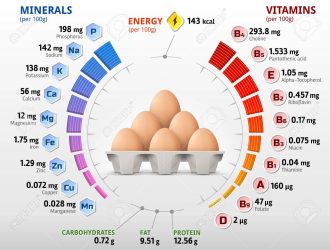
Following images reveal the composition of egg and its importance in our diet.
WISH YOU ALL HAPPY WORLD EGG DAY
– Dr. Malathi
-

The bulk density of animal feed varies significantly by type, ranging from roughly 15 to 45 pounds per cubic foot for pellets, or 0.5 to 0.7 kg per liter for compound feed, depending on ingredients, particle size, and processing methods. Ingredients like high-fiber forages and wheat middlings lower density, while high-density pellets can improve feed uniformity.